


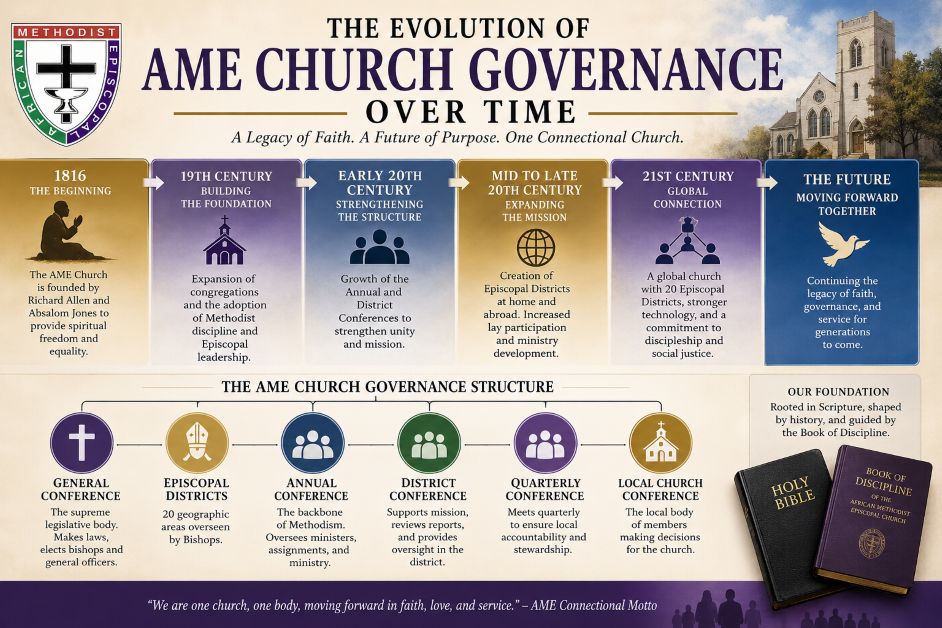
Understanding the Evolution of AME Church Governance Over Time reveals how leadership, accountability, and church order helped the denomination grow from a local movement born out of racial injustice into an international body serving members across multiple continents. The AME Church did not simply survive—it built a governance framework strong enough to preserve doctrine, maintain unity, and expand mission work worldwide.
For more than two centuries, the African Methodist Episcopal Church has remained one of the most influential Black denominations in Christian history. While many people know the inspiring story of Richard Allen and the founding of the denomination, fewer understand how its organizational structure developed into a global connectional system.
What Is AME Church Governance?
AME Church governance refers to the leadership structure, administrative systems, and decision-making processes that guide the African Methodist Episcopal Church.
The AME Church follows an episcopal form of government, meaning bishops serve as the chief executive and administrative leaders of the denomination. According to Member’s Class 102, “Episcopal refers to the form of government under which our church operates. The Episcopal form of government means that the chief executive and administrative officers of our denomination are the bishops of the church.”
This structure blends centralized leadership with connectional accountability, creating what is commonly called the connectional church governance system.
Under this model, no church functions in total isolation. Instead, every congregation is connected to:
- The Connectional Church
- Episcopal District
- Annual Conference
- District Conference
- Local Church governance system
This system has become a defining feature of the AME Church structure.
The Original Governance Model of the AME Church (1816)
The story of The Evolution of AME Church Governance Over Time begins with necessity.
In 1816, the African Methodist Episcopal Church was formally organized after Black worshippers experienced racial discrimination within white Methodist institutions. Member’s Class 102 explains that the AME Church formed because of “racial prejudice experienced by African Americans in the Methodist Episcopal Church.”
Richard Allen and Early Leadership
Richard Allen, founder of the AME Church, became the denomination’s first bishop. His election established episcopal leadership as foundational to AME governance. The manual states: “At that meeting, Allen was elected the first Bishop of the AME church.”
Allen understood that without formal governance, the new denomination could struggle to maintain order, discipline, and doctrinal consistency.
Early governance priorities included:
- protecting church autonomy
- appointing ministers
- organizing congregations
- establishing church discipline
This laid the foundation for the later AME conference system.
How the AME Conference System Developed
One of the most distinctive features in African Methodist Episcopal leadership is its conference-based governance.
General Conference: The Highest Authority
The General Conference is the supreme legislative body of the denomination.
According to the manual:
“The General Conference is indeed the supreme and most inclusive body of the AME church. It makes all laws that will govern all other branches, conferences, and departments of the church. It shall also select all Bishops and General Officers of the church.”
The General Conference oversees:
- Council of Bishops
- General Board
- Connectional Departments
- Episcopal Districts
- Annual Conferences
- District Conferences
This body became critical in the long-term development of AME Church organization history.
Annual Conference: The Backbone of Methodism
The Annual Conference became essential to Methodist governance.
The manual describes it as:
“The Annual Conference is the backbone of Methodism.”
Functions include:
- receiving ministerial reports
- assigning pastors
- evaluating leadership effectiveness
- maintaining accountability
Annual Conferences also reinforce the denomination’s connectional identity.
Historically, this structure allowed the AME Church to scale while preserving consistency.
Quarterly and District Conferences
As governance became more complex, additional conference layers emerged.
Quarterly Conference
Held four times yearly, the Quarterly Conference oversees:
- local leadership accountability
- ministry reporting
- stewardship review
- auxiliary accountability
The manual notes:
“The Quarterly Conference is held every three months or four times a year in every charge or circuit.”
District Conference
Held annually, the District Conference gathers district leadership for stewardship reports and planning.
These systems strengthened AME bishops and conferences by distributing governance responsibilities.
Expansion into a Global Church
A major chapter in The Evolution of AME Church Governance Over Time is international growth.
The manual states:
“The AME church is divided into twenty (20) geographical areas called Episcopal Districts.”
These include:
- 13 districts in the United States
- 6 districts in Africa
- 1 district including the Caribbean and parts of South America
This expansion required a more sophisticated AME Church governance structure.
Episcopal District Leadership
Each district is overseen by a bishop.
Bishops are elected by delegates of the General Conference and assigned every four years.
The manual explains:
“Every four years, bishops are assigned to Episcopal Districts by the Episcopal Committee of the General Conference.”
Interestingly, newly elected bishops traditionally receive their first assignment in Africa.
This reinforces the denomination’s global mission and leadership development.
Key Leadership Roles in Modern Governance
Modern African Methodist Episcopal leadership depends on several offices working together.
Bishops
Bishops oversee:
- conferences
- districts
- charges
- pastors
- presiding elders
- lay leadership
Their responsibilities include advancing the mission of the church while maintaining governance order.
Presiding Elders
Presiding Elders function as the bishop’s administrative aides.
The manual explains:
“The Presiding Elders are the Bishop’s aides.”
Their role includes:
- supervising pastors
- implementing episcopal directives
- district oversight
- administrative coordination
Without Presiding Elders, bishops would struggle to manage large districts effectively.
Pastors
Pastors manage local congregations while remaining accountable to conference systems.
Responsibilities include:
- local spiritual leadership
- budget presentation
- ministry implementation
- Church Conference leadership
Lay Participation
Modern governance includes stronger lay representation than early AME governance.
Lay members now participate through:
- conference delegation
- church voting
- ministry leadership
- budget discussions
This has made the AME connectional church structure more participatory.
Major Governance Changes Over Time
The AME Church has evolved significantly since 1816.
Early Governance
Early structure was simpler:
- founder-led leadership
- limited conferences
- regional concentration
- smaller membership base
Modern Governance
Today’s system includes:
- global districts
- specialized boards
- expanded conferences
- structured accountability
This reflects the maturation of AME Church organization history.
Early vs Modern AME Governance
| Early Governance | Modern Governance |
|---|---|
| Founder-led leadership | Global leadership system |
| Limited administrative layers | Multi-level governance |
| Smaller membership base | International membership |
| Emerging discipline | Formal Book of Discipline |
| Limited lay roles | Expanded lay representation |
This comparison highlights the remarkable transformation of the denomination.
Challenges Facing AME Governance Today
Like any large denomination, the AME Church faces modern governance challenges.
Leadership Accountability
Large organizations require transparency, ethical leadership, and accountability systems.
Global Communication
International governance adds complexity in:
- travel
- digital coordination
- cultural diversity
- resource distribution
Maintaining Doctrine While Adapting
The denomination must preserve identity while responding to changing times.
These realities continue shaping The Evolution of AME Church Governance Over Time.
Why AME Governance Still Matters Today
Governance is more than administration.
Strong governance protects:
- doctrine
- mission
- leadership continuity
- member accountability
- global unity
Without governance, the denomination could lose organizational clarity and mission focus.
The conference system, episcopal oversight, and connectional identity remain central to the church’s stability.
As the manual reminds members, the AME Church is a connectional church, meaning members belong not only to a local congregation but to a wider spiritual and organizational body.
Final Thoughts on The Evolution of AME Church Governance Over Time
The African Methodist Episcopal Church began as a bold response to injustice but endured because of structure.
From Richard Allen serving as the first bishop to today’s global conference system, the denomination built a governance model designed for growth, accountability, and mission.
Understanding The Evolution of AME Church Governance Over Time helps members appreciate not only where the church has been, but why its structure continues to matter.
Governance is not simply bureaucracy—it is the framework that helps preserve faith, mission, and connection across generations.
How has AME Church governance impacted your church experience? Share your thoughts in the comments below, and don’t forget to share this article with fellow members, ministry leaders, and students of African Methodist Episcopal history.
0 Comments