


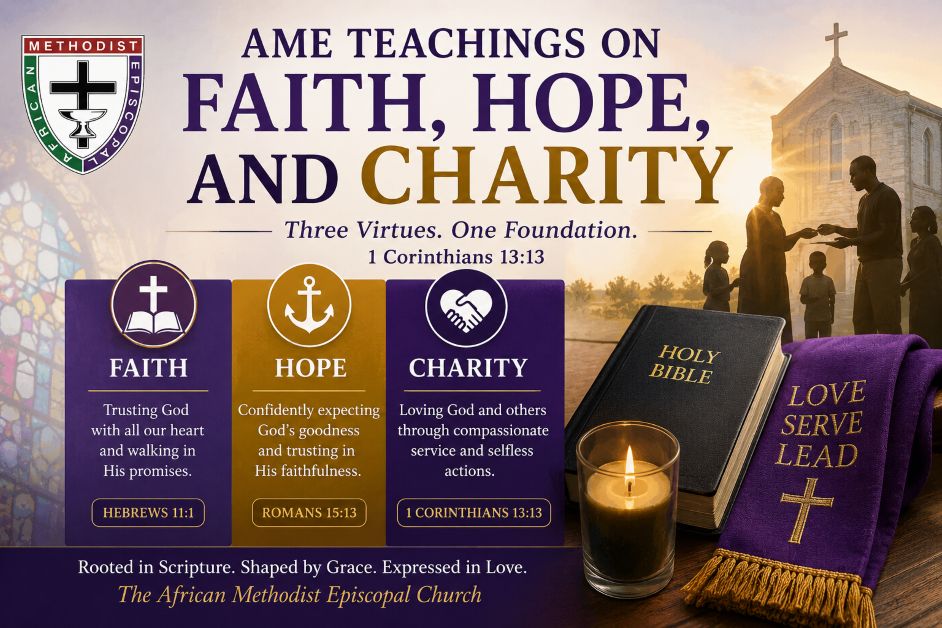
Understanding AME Teachings on Faith, Hope, and Charity helps members and spiritual seekers connect biblical truth with practical Christian living. These virtues are not simply theological ideas—they are daily disciplines that strengthen believers, guide church communities, and reflect the character of Christ.
Faith, hope, and charity are among the most essential virtues in Christian living. While these virtues are central to the broader Christian faith, the African Methodist Episcopal Church teaches them through a lens deeply shaped by Scripture, discipleship, service, and perseverance through adversity.
The AME Church has historically emphasized both spiritual growth and active service. As the church continues its mission across the world, these virtues remain foundational to the life of every believer.
What Are Faith, Hope, and Charity in Christian Teaching?
Before exploring AME Teachings on Faith, Hope, and Charity, it is important to understand their biblical meaning.
Faith: Trusting God Completely
Faith is confidence in God, His promises, and His power.
Hebrews 11:1 defines faith as:
“Now faith is the substance of things hoped for, the evidence of things not seen.”
In Christian life, faith means trusting God even when circumstances are uncertain.
Within AME faith teachings, faith includes:
- believing in God’s sovereignty
- trusting Christ for salvation
- obeying Scripture
- walking by spiritual conviction rather than fear
The AME Church strongly emphasizes salvation through faith in Jesus Christ.
According to Member’s Class 102, one of the central beliefs of the church is that “all who truly repent and believe in Jesus Christ are justified and saved.”
This reflects the church’s theological foundation in grace and faith.
Hope: Confidence in God’s Promises
Hope is more than wishful thinking. Biblical hope is confident expectation rooted in God’s faithfulness.
Romans 15:13 teaches:
“Now the God of hope fill you with all joy and peace in believing.”
In Christian hope in the AME Church, hope helps believers remain steadfast during hardship, uncertainty, and suffering.
Hope is especially meaningful in AME history because the denomination itself was born during a time of racial injustice and social struggle.
The AME Church emerged from a community that needed spiritual hope alongside social dignity.
As the church manual explains, the denomination was organized following “racial prejudice experienced by African Americans in the Methodist Episcopal Church.”
This historical reality gives hope a particularly powerful meaning within the AME tradition.
Charity: Love in Action
Charity is often misunderstood as merely giving money. Biblically, charity refers to Christian love expressed through action.
1 Corinthians 13:13 states:
“And now abideth faith, hope, charity, these three; but the greatest of these is charity.”
The biblical charity meaning is sacrificial love modeled after Christ.
This includes:
- compassion
- generosity
- service
- forgiveness
- community care
Within AME Church beliefs on love, charity is not a passive emotion but an active ministry.
AME Doctrine on Faith, Hope, and Charity
A major distinction in AME Teachings on Faith, Hope, and Charity is how these virtues are connected to doctrine and church life.
The AME Church is grounded in Scripture and Methodist theology.
The church manual teaches:
“The Holy Bible is the inspired Word of God and contains all things necessary to salvation.”
This means faith is rooted in biblical authority.
Faith as Spiritual Foundation
In African Methodist Episcopal doctrine, faith begins with belief in God and trust in Jesus Christ.
Faith is strengthened through:
- prayer
- worship
- preaching
- Bible study
- obedience to God’s Word
AME members are encouraged to cultivate personal faith while participating in the connectional life of the church.
The manual describes members as belonging not only to a local church, but to the wider connectional body.
This reinforces communal faith development.
Hope as Endurance and Perseverance
Hope is closely tied to endurance.
The AME Church has historically ministered to people facing injustice, poverty, and social barriers.
Because of this, hope is not theoretical.
It is lived through:
- perseverance in trials
- confidence in God’s justice
- expectation of eternal life
This makes Christian virtues faith, hope, and charity deeply practical within AME teaching.
Hope reminds believers that suffering is not the end of the story.
Charity as Ministry and Service
In AME Teachings on Faith, Hope, and Charity, charity is visible through ministry.
The church has a long history of service through:
- education
- missions
- benevolence
- outreach
- social justice work
The denomination’s mission has always included caring for both spiritual and practical needs.
This makes charity a defining feature of AME identity.
Why Faith, Hope, and Charity Matter in the AME Church
These virtues are essential because they shape Christian discipleship.
Faith Builds a Strong Spiritual Life
Without faith, Christian growth is unstable.
Faith helps believers:
- trust God in uncertainty
- remain spiritually grounded
- develop obedience
In AME faith teachings, members are encouraged to maintain spiritual discipline.
This includes:
- regular worship attendance
- scripture reading
- prayer life
- fellowship participation
Hope Sustains Believers in Difficult Seasons
The history of the AME Church makes hope especially significant.
Founded during racial oppression, the denomination embodies hope through resilience.
Richard Allen and early AME leaders demonstrated hope by building institutions despite opposition.
This historical witness still inspires believers today.
Hope enables Christians to:
- endure hardship
- remain confident in God
- look forward with spiritual expectation
Charity Reflects Christ to the World
Charity transforms doctrine into action.
A church that teaches love must practice love.
This includes:
- serving the poor
- supporting members in crisis
- community outreach
- mentoring youth
- encouraging one another
In the AME tradition, charity is both personal and communal.
This reflects the heart of Christ.
Richard Allen as an Example of Faith, Hope, and Charity
No discussion of AME Teachings on Faith, Hope, and Charity is complete without Richard Allen.
Faith in Action
Allen’s faith led him to establish an independent Black denomination grounded in Christian dignity and spiritual autonomy.
The church manual notes that in 1816, Allen was elected the first bishop of the AME Church.
This leadership decision shaped the future of the denomination.
Hope Amid Adversity
Allen demonstrated extraordinary hope while confronting exclusion and injustice.
Rather than abandon faith, he strengthened it.
This remains a powerful example for believers navigating hardship.
Charity Through Community Leadership
Allen also modeled charity by serving both church and community.
His leadership reflected love through action, institution-building, and service.
This continues to shape AME Church beliefs on love.
Practical Ways to Live Out Faith, Hope, and Charity
Theology becomes meaningful when practiced daily.
How to Practice Faith Daily
Ways to strengthen faith:
- daily prayer
- Bible meditation
- worship attendance
- trusting God in decisions
These habits build spiritual consistency.
How to Strengthen Hope
Hope grows through:
- remembering God’s faithfulness
- worship
- testimonies
- Christian fellowship
Believers facing hardship can anchor themselves in God’s promises.
Ways to Practice Charity
Practical expressions of charity include:
- helping someone in need
- volunteering in ministry
- encouraging others
- financial generosity
- community service
This embodies the true biblical charity meaning.
Faith, Hope, and Charity in AME Ministry
These virtues are also central to ministry life.
Missions and Evangelism
Faith motivates outreach.
The church continues global ministry through evangelism and missions.
Stewardship and Giving
Charity includes responsible stewardship.
Giving supports:
- ministry operations
- missions
- benevolence
- education
Community Service
The AME Church historically integrates ministry with community care.
This includes:
- food assistance
- education initiatives
- justice advocacy
- pastoral care
These ministries demonstrate living charity.
Bible Verses About Faith, Hope, and Charity
Important faith, hope, and charity scriptures include:
- Hebrews 11:1
- Romans 15:13
- 1 Corinthians 13:13
- Galatians 5:6
- Colossians 3:14
These verses reinforce the theological foundation of these virtues.
Why Charity Is Called the Greatest
Scripture says charity is greatest because love is the fullest expression of Christian maturity.
Faith trusts God.
Hope expects from God.
Charity reflects God.
Love transforms belief into visible witness.
This is why AME Teachings on Faith, Hope, and Charity place strong emphasis on service and compassion.
AME Teachings on Faith, Hope, and Charity
The African Methodist Episcopal Church teaches that faith, hope, and charity are more than virtues to admire—they are virtues to practice.
Faith anchors believers in God.
Hope sustains them through adversity.
Charity enables them to serve others with Christlike love.
These principles have shaped the AME Church from its founding to the present.
Through doctrine, ministry, and daily discipleship, AME Teachings on Faith, Hope, and Charity continue guiding believers toward spiritual maturity and meaningful service.
As Christians seek to grow in grace, these virtues remain essential.
How do faith, hope, and charity shape your spiritual journey? Share your thoughts in the comments below and share this article with others seeking to deepen their Christian walk.

0 Comments