


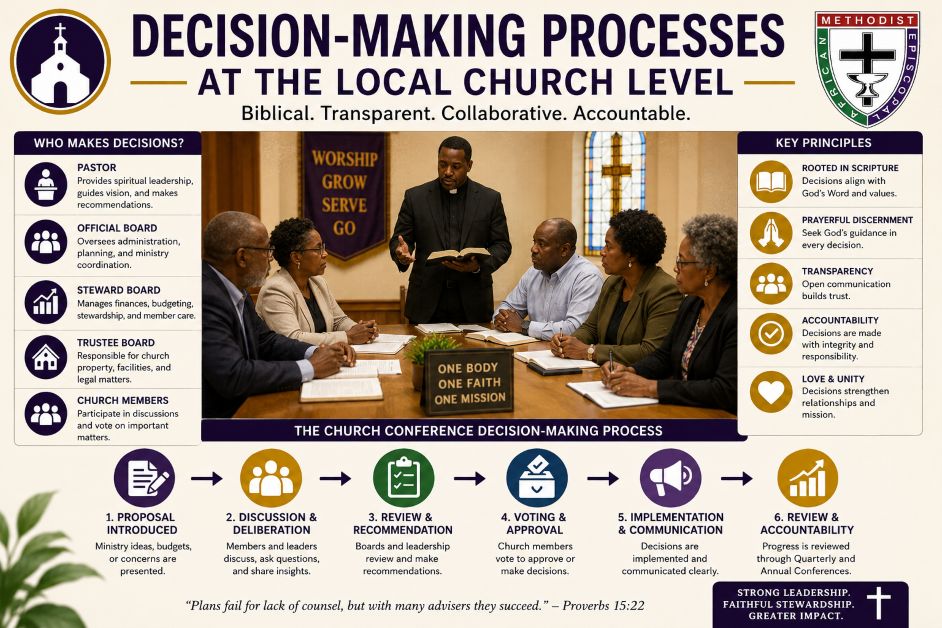
Understanding Decision-Making Processes at the Local Church Level is essential for pastors, ministry leaders, church officers, and members who want to better understand church governance, accountability, and member participation. In the African Methodist Episcopal Church, local church decision-making is intentionally structured to balance spiritual leadership, administrative order, and connectional accountability.
Every local church makes decisions that influence ministry, finances, worship, outreach, and the spiritual direction of the congregation. From approving budgets to launching new ministries, local church decisions affect both the daily operations and long-term mission of the church.
Yet many members participate in church life without fully understanding how decisions are actually made.
This article explores Decision-Making Processes at the Local Church Level, including leadership roles, church conferences, voting procedures, financial approvals, and governance oversight within the AME Church.
What Are Decision-Making Processes at the Local Church Level?
Decision-Making Processes at the Local Church Level refer to the systems, leadership structures, and formal procedures used by a church to make decisions regarding ministry, finance, administration, and operations.
These decisions may involve:
- approving ministry programs
- adopting budgets
- maintaining church property
- electing officers
- organizing outreach efforts
- addressing member concerns
Healthy local church governance process ensures that decisions are made with accountability, transparency, and alignment with the church’s mission.
Church decision-making is not meant to be random or personality-driven. Instead, it should combine:
- spiritual discernment
- biblical wisdom
- leadership responsibility
- member participation
This creates stability and order.
Why Church Decision-Making Matters
Church decisions shape both ministry effectiveness and congregational trust.
Strong church leadership decision making helps churches:
- maintain financial accountability
- preserve doctrinal integrity
- manage resources wisely
- resolve conflicts fairly
- support ministry growth
Poor decision-making, by contrast, can create confusion, conflict, and operational inefficiency.
This is why structured governance matters.
Who Makes Decisions at the Local Church Level?
A major component of Decision-Making Processes at the Local Church Level is understanding leadership roles.
In the AME Church, decision-making is shared among several leadership bodies.
The Pastor’s Role in Church Decisions
The pastor serves as the spiritual and administrative leader of the local church.
According to Member’s Class 102, the pastor is responsible for local leadership and accountability within the congregation. The pastor also works within the wider connectional structure of the denomination.
The pastor typically:
- leads ministry vision
- presides over meetings
- makes recommendations
- oversees church operations
- provides spiritual leadership
However, pastors do not function independently of governance systems.
This balance strengthens AME local church governance.
The Official Board
The Official Board plays a major role in local administration.
This board generally assists with:
- church planning
- administrative oversight
- ministry coordination
- policy recommendations
The Official Board serves as a key component of the church administration structure.
It helps ensure that leadership decisions are collaborative rather than isolated.
The Steward Board
The Steward Board is especially important in church financial decision making.
Responsibilities often include:
- financial oversight
- budget preparation
- member care
- ministry support
- stewardship planning
Strong financial governance builds trust within the congregation.
Transparent stewardship is essential for healthy church administration.
The Trustee Board
The Trustee Board oversees physical and legal assets.
Responsibilities include:
- church property maintenance
- building repairs
- facility management
- legal property matters
This makes trustees essential to local operational continuity.
Trustees are particularly involved when churches consider:
- renovations
- construction projects
- land or property decisions
Church Members and Voting Participation
Healthy governance includes member participation.
Church members may participate in decisions involving:
- major ministry changes
- leadership elections
- budget approvals
- property matters
This reflects the participatory nature of Decision-Making Processes at the Local Church Level.
Members are not passive observers; they are stakeholders in church life.
The Church Conference Process
One of the most important mechanisms in church conference process is the Church Conference.
According to the AME manual:
“The Church Conference is composed of all full members in good and regular standing.”
This makes the Church Conference an important decision-making body.
What Is a Church Conference?
A Church Conference is a formal gathering where members address matters affecting the congregation.
Topics may include:
- reports
- budgets
- ministry proposals
- officer elections
- recommendations
This structure promotes accountability and order.
How Proposals Are Introduced
In many churches, proposals originate through leadership or ministry teams.
Examples include:
- launching a new ministry
- adjusting budgets
- approving outreach initiatives
- recommending facility improvements
These proposals are reviewed before being presented for broader discussion.
Discussion and Deliberation
Before decisions are finalized, members and leaders discuss proposals.
This stage allows for:
- questions
- clarification
- recommendations
- feedback
Healthy discussion improves decision quality.
Voting and Approval
After discussion, formal voting may occur.
Depending on the issue, approval may require:
- majority vote
- board approval
- conference ratification
Voting provides procedural legitimacy.
This is a critical part of local church governance process.
Financial Decision-Making at the Local Church Level
Financial stewardship is one of the most sensitive aspects of church governance.
Strong church financial decision making protects both ministry integrity and member trust.
Budget Preparation and Review
Budgets are typically prepared through financial leadership and reviewed collaboratively.
This includes:
- ministry allocations
- operational expenses
- outreach funding
- facility costs
Budget discussions often involve both leadership and membership.
Expense Approvals
Churches should have approval systems for expenditures.
This prevents:
- unauthorized spending
- poor financial controls
- accountability gaps
Expense approvals help preserve transparency.
Stewardship Oversight
Financial oversight should include:
- regular reporting
- audits or reviews
- responsible recordkeeping
Strong stewardship is both practical and spiritual.
Property and Facility Decisions
Church property decisions are another major part of Decision-Making Processes at the Local Church Level.
Building Projects and Repairs
Decisions may include:
- roof repairs
- HVAC replacement
- accessibility upgrades
- construction projects
These often require Trustee involvement.
Property Purchases or Sales
Large property decisions generally require broader approval.
Because these decisions affect the church long-term, governance processes are critical.
Conflict Resolution in Church Decisions
No church is immune to disagreement.
Healthy governance includes systems for managing conflict.
Handling Disagreements
Church disagreements may involve:
- ministry direction
- finances
- leadership expectations
- procedural concerns
Conflict should be handled with prayer, communication, and fairness.
Appeals and Escalation
Some matters require escalation beyond the local level.
The AME Church’s connectional system allows oversight through broader structures.
Connectional Oversight Beyond the Local Church
A unique strength of AME local church governance is connectional accountability.
The manual explains:
“The Quarterly Conference is held every three months or four times a year in every charge or circuit.”
Quarterly Conferences provide local oversight and accountability.
Quarterly Conference Oversight
Quarterly Conferences review:
- ministry performance
- administrative matters
- leadership accountability
This adds another layer of governance.
Annual Conference Accountability
The AME manual states:
“The Annual Conference is the backbone of Methodism.”
Annual Conferences oversee:
- pastors
- ministry reports
- leadership accountability
- denominational connection
This ensures local churches remain connected to the wider denomination.
Best Practices for Healthy Church Decision-Making
Strong church leadership decision making depends on healthy habits.
Transparency
Members should understand how decisions are made.
Transparency builds trust.
Prayerful Discernment
Church decisions should be rooted in prayer and spiritual wisdom.
Decision-making is not merely administrative.
It is also spiritual stewardship.
Clear Communication
Leaders should communicate:
- proposals
- rationale
- outcomes
Poor communication often creates avoidable conflict.
Accountability Systems
Checks and balances strengthen governance.
Shared leadership prevents concentration of power.
Common Challenges in Local Church Decisions
Churches often face challenges such as:
- leadership conflict
- financial disagreements
- communication breakdowns
- low participation
Awareness of these challenges helps churches improve governance systems.
Why Structured Decision-Making Matters
Without structured governance, churches risk:
- confusion
- inefficiency
- distrust
- mission drift
Strong church board responsibilities and governance procedures help churches remain organized, accountable, and mission-focused.
This is why Decision-Making Processes at the Local Church Level are so important.
Decision-Making Processes at the Local Church Level
Healthy churches do not rely solely on charisma or informal leadership.
They rely on systems.
Understanding Decision-Making Processes at the Local Church Level helps members appreciate how governance protects ministry, finances, doctrine, and congregational health.
Within the AME Church, these processes combine:
- pastoral leadership
- board oversight
- member participation
- conference accountability
Together, these create a balanced governance structure.
As churches navigate ministry challenges, growth opportunities, and changing community needs, strong decision-making systems remain essential.
How does your church approach local decision-making? Share your thoughts in the comments and share this article with pastors, officers, and ministry leaders seeking stronger church governance.
0 Comments