


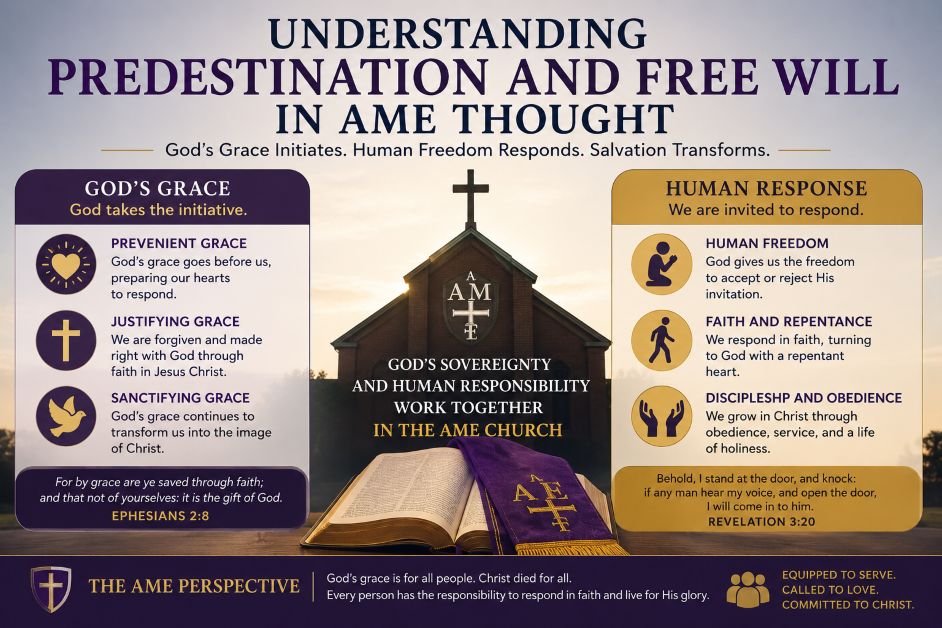
This article explores Understanding Predestination and Free Will in AME Thought, examining how AME theology balances God's sovereignty with human choice, how Wesleyan theology shapes denominational beliefs, and why this doctrine remains important for Christian discipleship today.
Few Christian doctrines have generated as much discussion and debate as predestination and free will. For centuries, theologians, pastors, and believers have wrestled with questions about God's sovereignty, human responsibility, salvation, and grace. Does God predetermine who will be saved? Do individuals genuinely have a choice in accepting God's offer of salvation? Can both divine sovereignty and human freedom exist together?
For members of the African Methodist Episcopal Church, these questions are answered through a theological framework deeply rooted in the teachings of John Wesley and the Wesleyan-Arminian tradition. Unlike some theological systems that emphasize absolute predestination, AME doctrine stresses God's universal love, prevenient grace, and humanity's responsibility to respond to God's invitation.
What Do Predestination and Free Will Mean?
Before examining the AME perspective, it is important to understand the basic definitions.
What Is Predestination?
Predestination and free will discussions often begin with the concept of predestination. In Christian theology, predestination refers to God's eternal purpose and foreknowledge regarding salvation. Certain theological traditions teach that God has predetermined who will be saved and who will not.
Biblical passages often associated with predestination include Romans 8:29–30 and Ephesians 1:4–5. These scriptures emphasize God's sovereignty and His divine plan for humanity.
However, interpretations vary significantly among Christian traditions.
What Is Free Will?
Christian free will refers to humanity's ability to make genuine moral choices. Within Christianity, free will means individuals can respond positively or negatively to God's invitation of salvation.
The Bible repeatedly presents people with choices. Joshua 24:15 famously declares, "Choose you this day whom ye will serve." Likewise, Revelation 3:20 portrays Christ inviting individuals to respond willingly to His call.
Why This Debate Matters
The discussion is not merely academic. Understanding predestination and free will affects how believers view:
- Salvation
- Evangelism
- Prayer
- Discipleship
- Christian responsibility
- Assurance of faith
For the AME Church, these doctrines directly influence how believers understand God's grace and their response to it.
The Biblical Foundations of Predestination and Free Will
The Bible contains passages that emphasize both God's sovereignty and human responsibility.
Scriptures Associated with Predestination
Several passages are commonly cited in discussions about election and divine purpose:
- Romans 8:29–30
- Ephesians 1:4–5
- Romans 9
- Acts 13:48
These texts emphasize God's foreknowledge and His role in salvation.
Scriptures Supporting Human Choice
Other passages emphasize human response and accountability:
- Joshua 24:15
- Deuteronomy 30:19
- John 3:16
- Revelation 3:20
- 2 Peter 3:9
These verses suggest that God offers salvation broadly and invites people to respond.
Can Both Be True?
One of the central themes of God's sovereignty and human responsibility is that Scripture presents both realities simultaneously. The AME Church teaches that God remains sovereign while still granting humans meaningful freedom to respond to His grace.
This balance forms the heart of Wesleyan-Arminian doctrine.
The Wesleyan-Arminian Heritage of the AME Church
To understand AME Church beliefs, one must understand the influence of John Wesley.
John Wesley's Understanding of Salvation
John Wesley taught that salvation originates entirely from God's grace. Humanity cannot save itself. Yet God graciously enables every person to respond to Him.
This emphasis became foundational to the Methodist doctrine of salvation.
Wesley rejected the idea that God arbitrarily selects some individuals for salvation while excluding others. Instead, he emphasized God's desire for all people to be saved.
How Wesleyan Theology Influenced the AME Church
The African Methodist Episcopal Church emerged from the Methodist movement, founded upon Wesley's teachings. When Richard Allen established the AME Church, he retained the essential theological framework of Methodism.
As a result, AME theology continues to affirm:
- Universal grace
- Human responsibility
- Holiness of life
- Sanctification
- Evangelism
- Christian discipleship
Why the AME Church Rejects Strict Predestination
The AME Church generally rejects strict deterministic views of predestination because they appear inconsistent with:
- God's universal love
- Christ's atoning sacrifice for all humanity
- Biblical calls to repentance
- Human accountability
Instead, the denomination teaches that God's grace is available to everyone.
Understanding Grace in AME Theology
A key distinction of Wesleyan theology involves its understanding of grace.
What Is Prevenient Grace?
One of the most important concepts in AME theology is prevenient grace.
Prevenient grace refers to God's grace that goes before salvation. Before an individual seeks God, God is already at work drawing that person toward Himself.
This grace:
- Awakens spiritual awareness
- Convicts of sin
- Enables faith
- Restores the ability to respond to God
Without prevenient grace, no one could come to God.
What Is Justifying Grace?
Justifying grace refers to God's act of forgiving sin and declaring believers righteous through faith in Jesus Christ.
Salvation is not earned through works. It is received through faith made possible by God's grace.
This teaching safeguards the biblical truth that salvation is a gift from God.
What Is Sanctifying Grace?
After conversion, believers continue growing through sanctifying grace.
Sanctification involves:
- Spiritual growth
- Christian maturity
- Holiness
- Transformation into Christlikeness
This emphasis on ongoing spiritual development remains central to both AME Church beliefs and discipleship.
How the AME Church Understands Free Will
The AME Church teaches that grace and free will work together rather than opposing one another.
Human Responsibility in Salvation
God initiates salvation through grace, but individuals must respond.
People may:
- Accept God's invitation
- Reject God's invitation
- Delay responding to God's call
This understanding preserves meaningful human choice while recognizing God's prior action.
The Relationship Between Grace and Choice
According to Wesleyan-Arminian doctrine, free will does not operate independently of God. Instead, God's grace empowers individuals to make genuine choices.
In this view:
- Grace comes first.
- Human response follows.
- Salvation remains entirely dependent upon God's initiative.
Does Free Will Mean Salvation Is Earned?
A common misunderstanding is that free will somehow makes salvation a human achievement.
The AME Church rejects this idea.
Salvation remains a gift of grace. Human response does not earn salvation; it simply receives what God freely offers.
Predestination in Wesleyan and AME Thought
God's Foreknowledge Versus Predetermination
One important distinction in Understanding Predestination and Free Will in AME Thought is the difference between foreknowledge and predetermination.
God's foreknowledge means:
- God knows future events.
- God knows human choices.
- God exists beyond time.
However, knowing an event will occur does not necessarily cause that event.
AME theology generally understands predestination through God's foreknowledge rather than deterministic control.
Corporate Election and God's Plan
Many Wesleyan theologians emphasize corporate election rather than individual predestination.
This perspective suggests that God predestined:
- The Church
- The Body of Christ
- The community of believers
Individuals become part of that community through faith.
Why God's Sovereignty Remains Essential
Although the AME Church emphasizes free will, it also strongly affirms God's sovereignty.
God remains:
- Creator
- Sustainer
- Redeemer
- Judge
- Lord of history
The balance between divine sovereignty and human freedom remains a defining feature of AME theology.
Richard Allen and Early AME Perspectives
The theological foundations of the AME Church reflect the influence of both Methodism and Richard Allen's ministry.
Methodist Roots of the AME Church
Richard Allen embraced the teachings of John Wesley and maintained Methodist doctrines concerning salvation and grace.
Consequently, early AME leaders taught:
- Salvation by faith
- Universal grace
- Human responsibility
- Evangelistic outreach
Richard Allen's Commitment to Human Responsibility
Richard Allen consistently encouraged personal faith, repentance, and Christian living.
His ministry emphasized that individuals must respond actively to God's call.
Early AME Views of Salvation
The early denomination understood salvation as:
- Initiated by grace
- Received through faith
- Confirmed through transformed living
This theological perspective continues to influence AME churches today.
Practical Implications for Christian Living
The doctrine of predestination and free will has practical significance for daily faith.
How This Doctrine Shapes Prayer
Believers pray confidently because God remains sovereign. Prayer acknowledges dependence upon God's power while trusting His wisdom.
How It Influences Evangelism
If God's grace is available to all, evangelism becomes essential.
The AME Church strongly supports:
- Mission work
- Gospel proclamation
- Community outreach
- Christian witness
How It Strengthens Discipleship
The doctrine encourages believers to actively pursue spiritual growth.
This includes:
- Bible study
- Worship
- Service
- Stewardship
- Christian education
Stewardship and Christian Responsibility
Because individuals possess genuine moral responsibility, they are called to faithfully manage:
- Time
- Talents
- Resources
- Relationships
- Ministry opportunities
This connection between theology and practice strengthens discipleship.
Common Misunderstandings About Predestination and Free Will
Does Predestination Mean My Choices Do Not Matter?
No. AME theology teaches that human decisions remain meaningful and consequential.
Can Someone Resist God's Grace?
Yes. Through the lens of Wesleyan-Arminian doctrine, individuals may resist or reject God's invitation.
Does Free Will Make Salvation Human Achievement?
No. Salvation remains entirely dependent upon grace.
Why Do Christians Disagree?
Different interpretations of Scripture have produced multiple theological perspectives throughout church history.
These discussions continue today among various Christian traditions.
Understanding Predestination and Free Will in AME Thought
Requires recognizing the balance between God's sovereignty and human responsibility. Rooted in Wesleyan theology, the African Methodist Episcopal Church teaches that God's grace reaches every person while preserving the freedom to respond in faith.
Through prevenient grace, God initiates salvation. Through justifying grace, believers receive forgiveness and reconciliation. Through sanctifying grace, Christians continue growing into spiritual maturity.
This understanding distinguishes AME Church beliefs from strict deterministic interpretations while affirming God's authority, love, and universal desire for salvation. The result is a theology that encourages evangelism, discipleship, stewardship, and faithful Christian living.
For AME Christians, the message remains clear: God's grace invites every person into a relationship with Him, and each believer is called to respond through faith, obedience, and lifelong discipleship.

0 Comments